

The days of humans interacting with Google search are nearly over — AI is the new engine
The sun is setting on traditional search
For more than two decades, “google it” has been synonymous with finding information online. Car stereo installation in Barrie? Google it. Authentic pizza in Minden? Google it. Best hotel in Peterborough? Google it. But something fundamental is changing.
We’re rapidly moving away from a world where humans browse search results themselves, and toward one where AI does the searching, filtering, summarizing, and recommending for us. The traditional search engine results page — with those familiar blue clickable links — is quickly losing relevance. And businesses that still think search engine optimization (SEO) is only about ranking on page one are already behind the curve.
Google search quality has been declining for years
Let’s be honest: Google search hasn’t felt particularly honest or smart in a long time. What was once a remarkably effective way to discover useful websites has become riddled with:
- Sponsored results disguised as organic content
- SEO-driven articles written primarily for algorithms rather than humans
- Legacy domains dominating rankings through perceived authority and (often) paid-for backlinks
- Content farms optimized to react to keywords rather than answer real questions
- Endless listicles and affiliate pages designed to capture clicks
In many industries, genuinely deserving businesses are ranked beneath companies that either understand how to game the system, or have merely existed online for longer. Smaller brands with excellent products or services often struggle to compete against:
- Paid placements targeting competitors’ keywords and business names
- Websites that are popular for the wrong reasons
- Technical SEO manipulation that Google keeps promising to punish
- Companies with huge content marketing budgets
- SMBs that can afford to enlist knowledgable UX and content designers
Users are noticing this, and they’re adapting.
People are starting to bypass Google search entirely
Increasingly, users are turning directly to AI tools like ChatGPT, Claude, Perplexity, Gemini (Google’s “AI Overview), Copilot, and more. Not because AI is trendy, but because it’s easier and faster. Instead of opening ten tabs and comparing contradictory content, users can ask actual questions:
“What’s the best online booking application for a small business?” Or: “Will social media really help my business grow?”
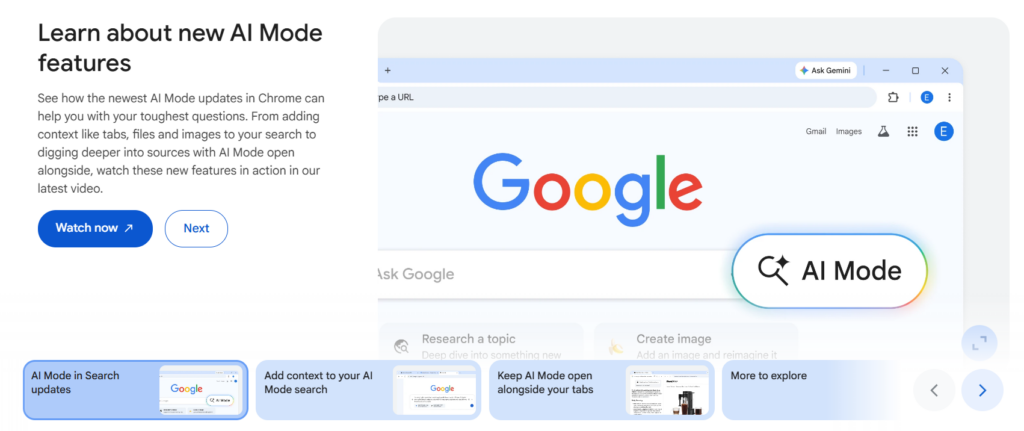
The AI synthesizes information, summarizes options, and provides recommendations in seconds. Google itself sees the shift happening. That’s why search results are now filled with:
- AI Overviews
- Gemini prompts
- Generated summaries
- Conversational follow-up suggestions
Google isn’t fighting AI. Google trying to become AI before users leave traditional search altogether.
The era of blue links is ending
The classic search model relied on humans acting as researchers:
- Search a phrase
- Scan results
- Open multiple websites
- Evaluate credibility
- Compare options manually
AI changes that behavior entirely. Now the user increasingly asks one question and receives one synthesized answer.
That means the future battleground isn’t just: “How do I rank #1?”
It’s becoming: “Will AI systems recognize my brand as trustworthy enough to recommend?”
That’s a very different challenge. Because in an AI-driven environment, visibility may no longer depend entirely on clicks or rankings. It may depend on whether large language models:
- Understand your expertise
- Can interpret your content clearly
- See consistent signals of credibility
- Encounter your brand across multiple trusted sources
- Find your website structurally easy to parse and summarize
“GEO” is the new buzzword, but is it useful?
I’ll go out on a limb and say NO. But it’s the new industry buzzword and many web design agencies are jumping on the bandwagon. GEO stands for generative engine optimization, and depending on who you ask, it’s either:
- A meaningful evolution of SEO; or
- Another buzzword created to confuse consumers and sell services
I’m living in the buzzword camp, but in practice, GEO refers to optimizing content and websites for AI-driven discovery rather than traditional search rankings alone. That includes things like:
- Structuring content clearly for machine interpretation
- Building topical authority
- Writing conversationally
- Using semantic context instead of keyword stuffing
- Creating genuinely useful information
- Ensuring technical accessibility for AI crawlers and summarization systems
Ironically, the rise of AI may push the internet back toward something Google originally claimed to reward: Helpful, human-centered content, instead of endless manipulation. Well, let’s hope that’s the case for a while anyway. In the long-term, we all know search will get basterdized and enshittified again. But I digress.
AI is becoming the middleman
This is the biggest shift businesses need to understand. In the old model: Humans interacted directly with search engines. In the emerging model: Humans interact with AI, and AI interacts with search engines and websites on their behalf. That changes everything. AI becomes:
- The researcher
- The filter
- The evaluator
- The summarizer
- The recommender
Users may never even visit ten different websites anymore. In some cases, they may visit none at all until they’re ready to buy. The implications are enormous for:
- SEO strategy
- Website architecture
- Content strategy
- Brand authority
- Conversion funnels
- Trust signals
Businesses that rely on traditional paid and organic traffic should be paying very close attention. The new search landscape will favour those in tune with AI.
What this means for modern websites
A modern website can no longer be built solely for human visitors or traditional Google crawlers. Websites increasingly need to communicate effectively with AI systems too. That means focusing on things that good web designers have been doing all along:
- Clear information architecture
- Strong semantic HTML structure
- Well-organized content hierarchies
- Direct, authoritative writing
- Consistent expertise signals
- FAQs and conversational content formats
- Technical performance and accessibility
- Structured data where appropriate
The goal isn’t just: “How do we rank?” anymore. It’s: “How do we become a trusted source AI wants to reference?” Because AI engines are increasingly deciding what content get surfaced in the first place, and which businesses humans will lay eyes on.
The companies that adapt early will have an advantage
Every major shift in digital behavior creates winners and losers. The businesses that adapted early to:
- Mobile-first design
- Social media marketing
- UX-focused websites
- Modern SEO practices
…gained massive advantages while competitors played catch-up. AI-driven discovery may represent an equally important shift. And while traditional SEO still matters today, it’s becoming part of a much larger ecosystem where:
- Search is conversational
- Discovery is synthesized
- Trust matters more than tricks
And AI increasingly controls the customer journey before a human ever reaches your website. The companies preparing for that future now will be in a far stronger position than those still optimizing exclusively for blue links.
Contact us for a free SEO audit