

Debunking the digital native myth: Why Millennials are the most internet-savvy generation
Touchscreens don’t teach tech literacy
Digital natives: While the definition is hotly contested, it’s generally a metaphor that refers to people who grew up surrounded by digital technology… the internet, computers, smartphones, apps, and social media. The term is contrasted with “digital immigrants,” which refers to people that moved from one culture to another and learned to adapt and use digital tools along the way.
The term “digital natives” is often used to describe Gen Z or Gen Alpha—the kids who could swipe a touchscreen before they could walk, or the teenagers who can edit a flawless video on TikTok in under 90 seconds. But if we strip away social media apps and look at the internet in its entirety—troubleshooting a router, managing file directories, evaluating source credibility, navigating complex desktop environments, and understanding how data actually moves—the crown belongs to a different group entirely.
Millennials (born 1981–1996) are the most comprehensively internet-savvy generation alive.
While younger generations are undoubtedly faster at mobile content creation (and consumption), Millennials occupy a unique historical sweet spot. They’re old enough to remember how the digital infrastructure was built, but young enough to have integrated it into their DNA. To understand why, we have to look at how the entire generational spectrum interacts with the web.
-
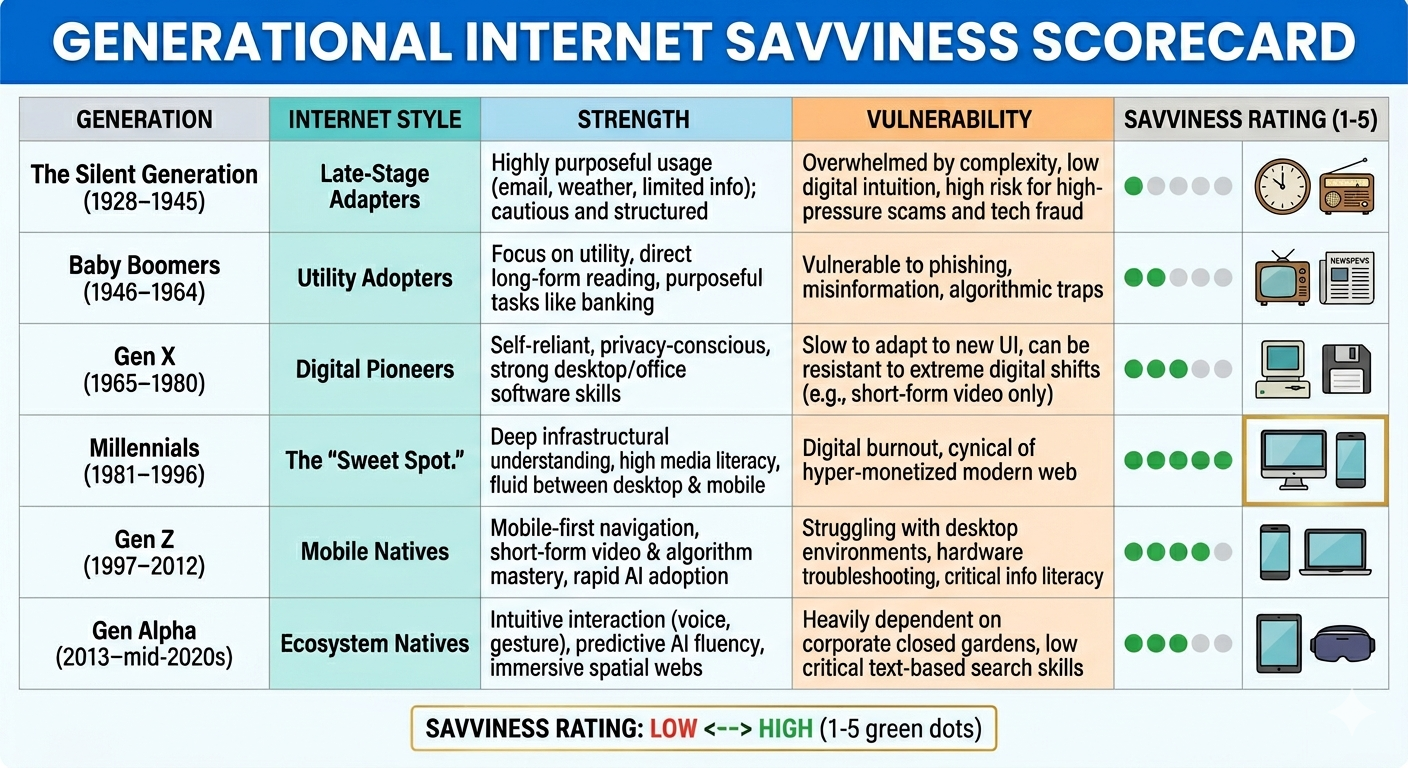
The Silent Generation (born 1928–1945): The Late-Stage Adapters
The Silent Generation witnessed the invention of television, the personal computer, and the internet all within their lifetimes, encountering the web well into their retirement years.
The style: Highly cautious and minimal. For the Silent Generation, the internet is mostly treated as an information kiosk or a digital post office. Their usage is almost exclusively text-based and linear, limited to specific, high-necessity tasks like reading email from grandchildren, checking a localized weather report, or occasionally looking up an address.
The savviness gap: Because they skipped the entire evolutionary arc of personal computing and digital user interfaces, they face an immense steep learning curve. Concepts like tabs, hyperlinks, pop-ups, and password management can feel overwhelming. They are highly susceptible to high-pressure internet scams and telephone-to-web tech support fraud, often lacking the digital intuition to realize when a screen has frozen versus when a system has been compromised.
-
Baby Boomers (born 1946–1964): The Utility Adopters
Baby Boomers came to the internet later in life, usually adapting out of necessity for work or to stay connected with family.
The style: Boomers view the internet as a tool or a utility, much like a television or a landline telephone. They use it intentionally for specific tasks: online banking, reading the news, booking travel, or sending emails.
The savviness gap: Because they didn’t grow up with the concept of “the feed” or algorithmic curation, Boomers are statistically the most vulnerable to online misinformation, phishing scams, and spoofed websites. They tend to take web interfaces at face value.
-
Gen X (born 1965–1980): The Digital Pioneers
Gen Xers were the young adults entering the workforce precisely when the commercial internet exploded. They are the true bridge between the analog and digital worlds.
The style: Highly practical and self-reliant. Gen X learned how to use computers using early command-line interfaces (like MS-DOS) and standard office software. They are incredibly proficient with the desktop web.
The savviness gap: While highly capable, Gen X generally treats the internet as a workspace or a digital library. They can be skeptical of or resistant to rapid, dramatic shifts in user experience (like shifting entirely to vertical-video interfaces) and are often slower to adopt cutting-edge tools like generative AI.
-
Millennials (born 1981–1996): The Sweet Spot
Millennials didn’t just grow up with the internet; they grew up alongside it, witnessing every major iteration from dial-up to fiber optic.
The style: Comprehensive and infrastructural. Millennials had to build, break, and configure the early web. They edited raw HTML for MySpace profiles, manually troubleshot DNS errors, and understand the difference between local file paths and the cloud.
Why they win: They possess absolute fluidity between desktop-class computing (complex software workflows, advanced search logic) and the modern mobile ecosystem. They were also heavily trained by educators to question internet sources (“Wikipedia isn’t a reliable source”), giving them the strongest baseline for digital literacy and media skepticism.
-
Gen Z (born 1997–2012): The Mobile Natives
Gen Z was born right as the web transitioned to mobile-first. They grew up on smartphones, high-speed Wi-Fi, and the rise of the “walled garden”—apps like Instagram, TikTok, and YouTube where the internet is curated for them.
The style: Hyper-efficient, collaborative, and fast. Gen Z is incredibly adept at navigating the social and creator economies, manipulating algorithms to find hyper-niche content, and rapidly adapting to AI tools.
The savviness gap: Because mobile operating systems hide file directories and eliminate glitches, tech educators note that many Gen Z users lack “under-the-hood” computer literacy. They often struggle with standard desktop workflows, file hierarchies, and troubleshooting hardware when an app doesn’t “just work.”
-
Gen Alpha (born 2013–Mid-2020s): The Ecosystem Natives
Gen Alpha is growing up in an era where the internet is ubiquitous, invisible, and deeply integrated into physical reality through smart devices, voice activation, and immersive gaming platforms like Roblox.
The style: Seamless and intuitive. To Gen Alpha, the internet isn’t a place you “go to” via a browser; it is the fabric of their environment. They interact with the web via voice commands, touchscreens, and highly visual, predictive AI environments.
The savviness gap: Alpha is heavily reliant on closed, corporate, hyper-optimized ecosystems. Because algorithms predict exactly what they want before they even search for it, they face an uphill battle with traditional text-based search, information literacy, and understanding how data security actually works behind the screen.
The Irony of the “digital native”
Educators and IT professionals are increasingly identifying a phenomenon known as technological illiteracy in digital natives. Because modern smartphones and tablets are so incredibly well-designed, younger users rarely have to figure out how a browser communicates with a server, what a file path is, or how to circumvent a software glitch. When a modern app breaks, you simply close it or reinstall it.
Millennials: Network engineers by necessity
But look back just a couple of decades, and the internet was a fragile, high-maintenance machine. Take Millennials, who took a gritty work-around mentality straight into the Wild West of the early consumer internet. When a Millennial’s connection broke in 2004, there was no automated troubleshooter or instant customer service; they had to act as their own network engineer. They had to open a black Command Prompt window, type strict syntactical strings like ipconfig /release and /renew to manually force a new IP address, and execute a precisely timed ritual of power-cycling a finicky modem under their desk—waiting exactly sixty seconds for the sequential green lights to turn solid—and pray.
They grew up custom-coding raw HTML and CSS stylesheets just to make their MySpace pages look cool, configuring complex file paths on peer-to-peer sharing networks, and dodging a barrage of computer viruses that forced them to learn how to wipe a hard drive and reinstall an operating system from a disc. They learned to meticulously organize digital file structures because search bars weren’t fast enough yet, and they spent hours managing restricted local hard drive space. Because the early web was fragile, clunky, and prone to breaking at every turn, Millennials became a generation that doesn’t just know how to tap an interface—they know how to operate the machinery behind it.
Gen X: The original workaround generation
Stepping back even further, Gen Xers possess that exact same foundational advantage over today’s digital natives, operating well outside the bubble of ever-changing social media platforms. They grew up wiring cable boxes, VCRs, and video game consoles behind tangled TV sets for their parents. They recorded vinyl to cassettes, dubbed tapes, and burned songs from Napster to CDs. They toted floppy discs in their backpacks and only made the mistake of saving an essay to a school computer’s local hard drive once. Later-born Gen Xers were the first to learn how to use email in college or university, which was a bizarre, abstract concept when compared to traditional letter mail. Nothing worked seamlessly for them, turning them into the original work-around generation who either learned to solve tech problems manually or did without.
Millennials win
While younger generations are undoubtedly faster at consuming and creating digital content on mobile platforms, and Gen Xers had to bridge analog and digital, and kick the tech door open, Millennials remain the most comprehensively internet-savvy generation. They understand the mechanics of how the web actually functions… they know how to operate the machine, not just interact with the interface.